Past the Sketch
AWARD School judges the idea, not the craft. You hand in sketches, and if the thought is good enough it survives being presented rough. That’s the whole point, and it’s the right way to run it.
Two of my briefs made the wall. Both only ever existed as drawings, a billboard and a four-frame storyboard, done by hand, enough to carry the idea and no further. Afterwards I wanted to see what AI could make of them. Not to redo the thinking, but to find out what these looked like as the things they were pretending to be.
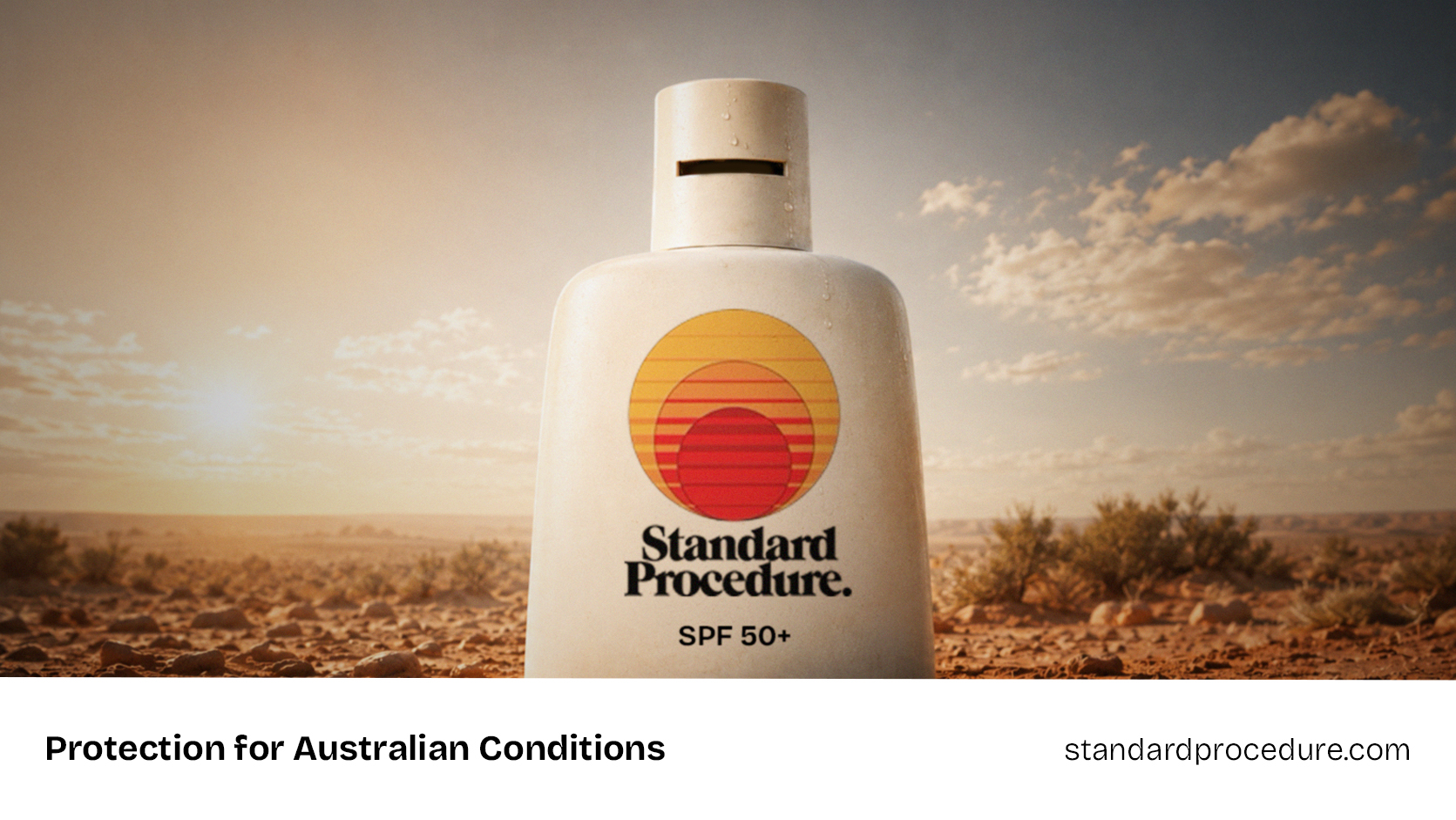
The billboard was the quicker of the two. Standard Procedure, an SPF 50+ sunscreen, so one image and one line, and the image has to carry it. Nothing to sequence, nowhere to hide. I used Claude to work through it and Photoshop to finalise, and it came together in a fraction of the time the film took.
The TVC was for the HiLux. Two campers in the shade on a hot afternoon, and the camera pulls back to reveal the shade is a boulder suspended over them, held by a HiLux on the clifftop. “Ahhh… bloody serene.” In a storyboard the reveal works because you’re reading four frames as a sequence of intentions. As footage it has to actually land, which is a different problem.
I used Veo 3, and the prompting turned out to be the smaller half of the job. Text alone kept giving me a boulder that wasn’t the right boulder, campers who changed between shots, a ute in the wrong spot. So I built the hero frames in Photoshop first, compositing the ute, the rock, the campers and the cliff into single images that looked the way I wanted, and used those as the starting point. Once it had a frame to work from instead of a sentence, it stopped inventing and started animating. Composite, prompt, watch it fail, adjust the composite, go again. Photoshop was doing the art direction. Veo was doing the motion. It took a lot of passes, and most of what I learned was about how to use the tool rather than what to ask it for.
AI doesn’t execute the idea. It gets you halfway, and halfway is closer to your vision than a sketch. You still have to close the distance yourself, and how far that distance is depends entirely on the medium and on how well you know the tool.